
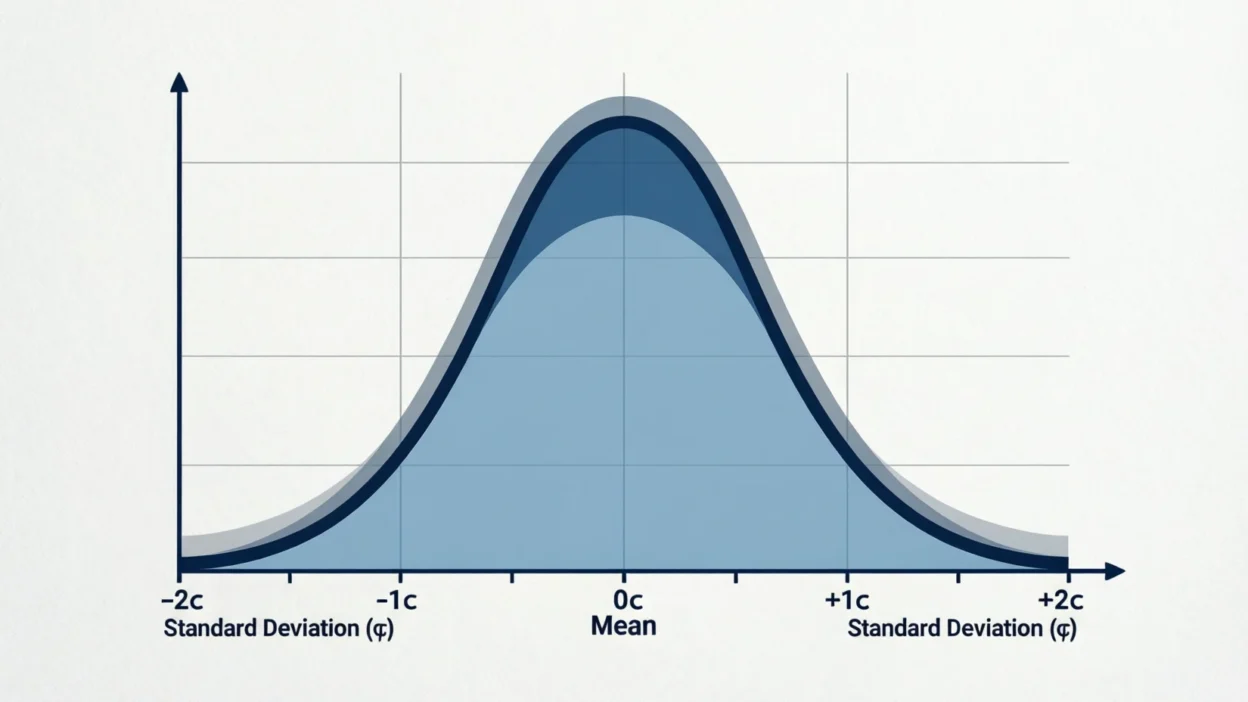
If you’ve ever seen numbers like test scores, income levels, or survey results, you may have come across the term standard deviation. It sounds technical, but the idea behind it is actually simple. Standard deviation helps us understand how spread out data is and whether values are close together or far apart.
Quick Answer:
Standard deviation measures how much numbers in a data set differ from the average (mean).
What Does Standard Deviation Mean?
Standard deviation tells you how spread out the data is.
- Low standard deviation → numbers are close to the average
- High standard deviation → numbers are far from the average
Simple meaning:
👉 It shows how consistent or variable the data is.
Example:
If most students scored near 80 on a test, the standard deviation is low.
If scores range from 40 to 100, the standard deviation is high.
Standard Deviation Explained Simply
Think of it like this:
- Imagine people standing around a pole (the average).
- If everyone stands close to the pole → low standard deviation
- If people are spread far away → high standard deviation
So, standard deviation answers this question:
“How far do values usually stray from the average?”
Why Is Standard Deviation Important?
Standard deviation is widely used because it helps:
- 📊 analyze data accurately
- 📚 compare test scores
- 💼 measure financial risk
- 🧪 evaluate scientific experiments
- 📈 understand trends and consistency
Real-Life Examples of Standard Deviation
- Education: Test score consistency
- Finance: Investment risk (higher deviation = higher risk)
- Sports: Player performance consistency
- Weather: Temperature variation
- Manufacturing: Quality control
Example sentence:
“The investment has high returns but also a high standard deviation.”
Standard Deviation vs Mean
| Term | Meaning |
|---|---|
| Mean | Average value |
| Standard Deviation | Spread of values around the mean |
Both are important, but they tell different stories about the data.
High vs Low Standard Deviation
| Type | What It Means |
|---|---|
| Low SD | Data is consistent |
| High SD | Data is unpredictable |
| Zero SD | All values are the same |
Simple Formula (Basic Idea)
You don’t need to memorize the formula, but conceptually it involves:
- Finding the average
- Measuring how far each value is from the average
- Averaging those distances
This produces the standard deviation.
FAQs About Standard Deviation
#### Is standard deviation always positive?
Yes. It’s never negative.
#### Can standard deviation be zero?
Yes—if all values are identical.
#### Is standard deviation hard?
The math can be complex, but the idea is simple.
#### Is standard deviation used outside math?
Yes—finance, science, psychology, sports, and more.
#### Does higher standard deviation mean better?
Not necessarily—it just means more variation.
Final Thought
Standard deviation is a powerful way to understand how much data varies from the average. Whether in school, finance, or daily life, it helps turn raw numbers into meaningful insight.

Rohan Ahmad was an author who wrote about biblical topics, spiritual interpretations, and scriptural insights, helping readers gain a deeper understanding of faith, symbolism, and meaningful biblical teachings.